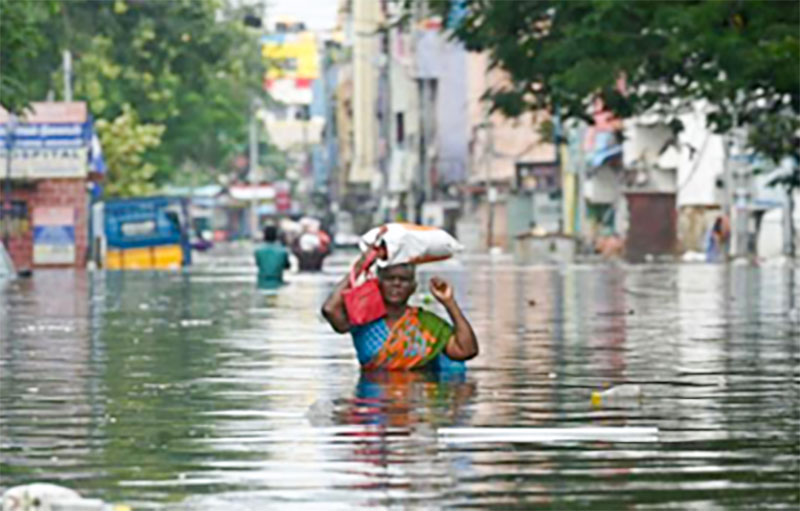
The story of frequent floods in Bihar highlights the convergence of micro and macro dimensions: everyday realities and lived experiences of displacement on the one hand, and embankments, agricultural losses, and broader flood-management challenges on the other. It brings out the differences between flooding in North and South Bihar and illustrates the lived experience of flood-induced displacement.
Introduction
In August, 2026, Prashant Kishor, founder of Jan Suraaj Party and the MLA of the Bankipur constituency of Bihar, remarked that ‘floods in Bihar happen every year just as the sun rises from the east every morning’. He severely criticized the present BJP government as well as previous JDU governments for their ineffectiveness in dealing with floods in Bihar.[i]
In another instance, while reading Dinesh Kumar Mishra’s recent book Pani ka Shaap: Bihar me Badh-Sukhad[ii] which is a detailed analysis of floods and droughts in Bihar from 1947 to 1956, I was struck by how persistent the problem remains. Nothing much seemed to have changed. Despite eight decades of independence, India has not been able to deal with the floods in Bihar.
In fact, the expansion of embankments has been massive but the frequency of floods has rather increased. Bihar had about 160 kms of embankments in 1954 when the flood prone area was 2.5 million ha. By 2026 the length of embankments had increased to more than 3730 kms, while the flood-prone area had risen to 6.88 million ha.
The comparison raises an important question: how should we make sense of this apparent paradox of embankments? The figures do not by themselves establish that embankments have caused the increase in flooding. But they do point to a problematic relationship between structural flood protection and the persistence of flood exposure. Embankments can protect particular areas while altering drainage, constraining river movement, increasing the consequences of breaches and overtopping, and transferring risks to other locations.
According to the state’s Disaster Management Department, nearly 50 lakh people across 15 districts of Bihar were affected by floods in September. This raises a fundamental question: “whether a flood-management strategy centred on containing rivers can adequately address the behaviour of rivers in a densely settled and sediment-rich floodplain.
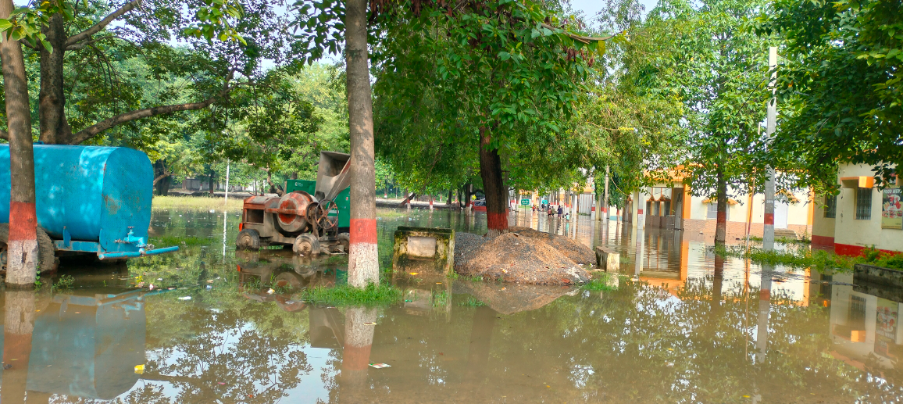
Administrative Block of Tilka Manjhi Bhagalpur University (Bihar) @Ruchi Shree
This raises a fundamental question: “whether a flood-management strategy centred on containing rivers can adequately address the behaviour of rivers in a densely settled and sediment-rich floodplain.”
Changing Typology of Floods
Megh Pyne Abhiyaan (MPA), an NGO based in Dhanbad, Jharkhand, has worked on flood-related issues for nearly two decades. Its work covers seven flood-affected districts of North Bihar: Supaul, Saharsa, Khagaria, Madhubani, Sitamarhi, Kishanganj, and West Champaran. The process is a collective of inhabitants and community-based practitioners from the Kosi-Bagmati-Kamla belt, working with local NGOs such as Gramyasheel in Supaul, Kosi Seva Sadan in Saharsa, Samta in Khagaria, and Ghoghardiha Prakhand Swarajya Vikas Sangh in Madhubani. MPA’has classified the different types of floods in Bihar. The typology is based on how water enters and moves through a settlement, such as through an embankment breach, a river overflowing, clogged drainage, or the interaction of several rivers.
In a recent article, Prasad writes that ‘Bihar’s floods do not end when the water recedes, as there is a long road to recovery for the flood-affected families. [iii] He argues that household-level assessment must become an integral part of post-flood response and recovery. With support from Tata Trusts MPA conducted an extensive study of 2,290 households across 134 wards and 21 panchayats in seven of North Bihar’s worst-hit districts. The study reveals that two families of same flooded village can emerge with entirely different losses and entirely different capacities to recover. Policy makers need to understand the different types of floods and their varied impact on local people.
Frequent Floods in South Bihar
Bihar and flood are considered as synonyms. The state experiences floods almost every year. Flooding is widely regarded as one of the factors contributing to the state’s economic backwardness even after eight decades of India’s independence. This is a long-standing problem that reflects a combined form of natural and human-induced disaster.
Floods occur in Bihar in two main ways. In some areas, they are associated with rising water levels in the the Ganga River, while in the northern Bihar region they are caused by the rising waters of rivers such as the Kosi. When the Ganga swells, areas such as Patna, Munger, and Bhagalpur can be affected, whereas when the Kosi rises, districts like Saharsa, Supaul, Madhepura, are exposed. Overall, 28 out of Bihar’s 38 districts are considered flood-prone.
In contrast, flooding along the Ganga is influenced by excess water flowing into the river from its large upstream basin, including the Himalayan and other tributaries. A review of the available literature on floods in Bihar suggests that research tends to focus more on floods in North Bihar. One reason could be the Kosi-centric flood discourse in Bihar. Because the river has caused devastating floods in the state over many years, colonial administrators labelled Kosi as the ‘Sorrow of Bihar,’ and this label continues even today.
Sedimentation in the Ganga and its tributaries also contributes to flooding.
In August 2008, following the breach of the Kosi Embankment at Kusaha in Nepal the Kosi began to flow in its older course in Nepal and areas of Bihar, causing extensive flooding and loss of life. The Kosi embankment had failed many times in the past and the 2008 failure was one such breach upstream of the barrage.
South Bihar also faces flooding though its extent is generally less extensive than in North and East Bihar. Sedimentation in the Ganga and its tributaries also contributes to flooding. To address the problem recently, the Government of Bihar approved a Silt Management Policy. [iv]
Experiences of Floods in Bhagalpur
When floods come, different sections of society are affected in different ways. Based on my experience of living in Bhagalpur for the past seven years, from 2019 to 2026, I have observed that within the same city, some areas are severely affected by floods, while other areas remain completely unaffected. The differences are also evident between urban and rural areas. People living in villages along the Ganga and its tributaries can lose their agricultural livelihoods for nearly two months.
During river research conducted in recent years, I spoke with residents in different parts of the district. Residents in rural areas repeatedly told me that earlier floods used to occur once every two to three years, but now they happen almost every year, and sometimes two to three times within a single year. For example, in 2025, my residential area in the Nathnagar block experienced three floods of varying intensity during August.
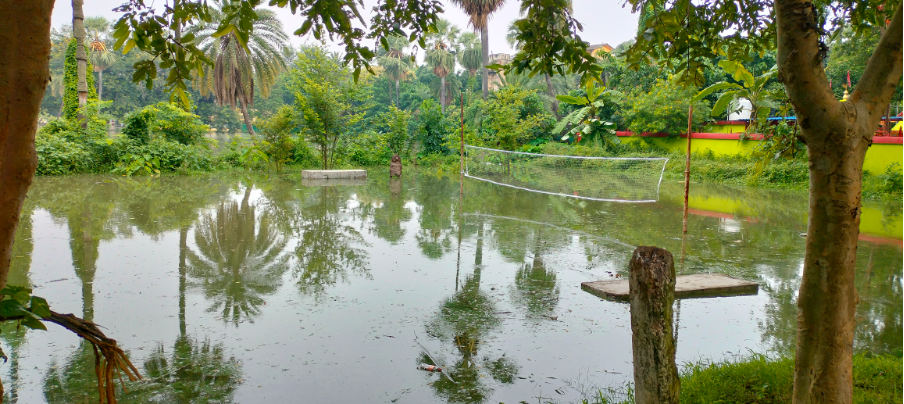
Submerged Lalbag Professors’ Colony of Bhagalpur University (Bihar) @Ruchi Shree
In 2024, the floods were severe in the third week of September. In such circumstances, people are forced to live in displacement for two to three months. The farmers living in the nearby areas shared that earlier they could grow two to three crops a year; in years of severe flooding, they are usually able to grow only one crop.
Similarly, fishermen from Kahalgaon and Nathnagar, two blocks of Bhagalpur district, have linked the continuously declining fish population in the rivers and the increasing frequency of floods to the construction of the Farakka Barrage. In 2026, I witnessed two rounds of floods – one of low intensity in the last week of August and another of high intensity in the first and second weeks of September. Thus, floods over the last three consecutive years have led to my displacement from one week to ten days every year. Seasonal displacement caused by floods is no longer just news I read. I have now experienced what it means to be temporarily homeless because of a flood.[v]
Whereas farmers earlier could grow two to three crops a year, in years of severe flooding, they are usually able to grow only one crop.
Conclusion
To sum up we can say the saga of floods in Bihar is endless. The problems caused by floods range from displacement to disrupted transportation, to loss of crops, livestock, houses and livelihoods. Yet most people accept flooding as a recurring phenomenon and part of everyday life.
One thing that has changed, however. Earlier floods were largely seen as natural disasters. Today people increasingly recognize that the scale of the problem is also shaped by human actions. After all, despite our immense scientific and technological progress, why have we failed to effectively deal with the floods in Bihar?
The answer is likely to be different to each one of us. To my mind, we have so far, failed to give due attention to nature and the environment, at the local level or international level. There is an urgent need to look beyond the conventional pursuit of economic growth and make greater space for ecological consideration.
[i] India Today (2026), Image-building exercise: Prashant Kishore on BJP Chief’s Donation for Bihar Flood, available at https://www.indiatoday.in/india/story/bihar-floods-prashant-kishor-slams-bjp-nitin-nabin-donation-image-building-exercise-2998554-2026-09-19
[ii] Dinesh Kumar Mishra (2026), Pani ka Shaap: Bihar me Badh-Sukhad, Rajkamal Prakashan, New Delhi.
[iii] Eklavya Prasad (2026), ‘Bihar’s floods do not end when the water recedes’, The Pioneer, New Delhi Edition, 19th Sep, available at https://dailypioneer.com/news/bihars-floods-do-not-end-when-the-water-recedes
[iv] Dev Raj (2026), Bihar Comes up with Silt Management Policy Amid Protests against Farakka Barrage and Ganga Water Sharing Treaty with Bangladesh, available at https://www.etvbharat.com/en/bharat/bihar-comes-up-with-silt-management-policy-amid-protests-against-the-farakka-barrage-and-ganga-water-sharing-treaty-with-bangladesh-enn26091502725
[v] To know more about the everydayness of floods in Bhagalpur, read Ruchi Shree (2021), https://sandrp.in/2021/09/01/the-everydayness-of-flood-experiences-from-bhagalpur-bihar/